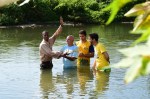
At Work on Purpose engages over 8,000 working Christians in Cincinnati, Ohio—across church homes, denominations, zip codes, and ministries. This presentation introduces the citywide marketplace ministry model of At Work on Purpose, a contemporary workplace expression of the 1st Century Ekklesia for post-Christian America. Learn about the identity, infrastructure, and initiatives that collectively form the foundation for citywide marketplace ministry…
The proliferation of books on the topic of the integration of faith, work, and economics over the past decade has multiplied available resources to the point of confusion at point. Whereas a decade or so ago, there were a handful of recent, high quality books on the subject that were often targeted to academic audiences, there are now dozens of…
Part four of a series. On my list of four things we can learn from the sacraments about vocation, the second is: My daily work uses material objects and actions as signs of spiritual realities. We began to look at the significance of this intersection last time, when we saw how the sacraments involve God having entered into time-space history to…
This is the first in a series of articles sharing insights from a joint curricular development initiative of the Oikonomia Network, the Theology of Work Project and three ON schools (Asbury, Assemblies of God and Western). Reprinted from ON. This March, Will Messenger of the Theology of Work Project and I met individually with 15 faculty on the campuses of three Oikonomia…
The purpose of the Faith@Work Summit is to gather active participants and leaders in the faith at work movement from every industry sector to learn from each other and work together to extend Christ’s transforming presence in workplaces around the world. The 2018 Faith at Work Summit, held in Chicago at the Hyatt Regency O’Hare on October 11th-13th, is now open for registration! The early bird pricing for registration is now available at $179 per ticket, so be sure to purchase soon.
The economic machine that is America continues to move forward but too often leaves many behind. While the Dow roars towards unprecedented heights, the poor and powerless reach new lows. But there is a solution that is both obvious and obscure: business. Business has changed lives of the less fortunate in the here and now when leaders and shareholders look beyond their own pocket. The principles and the experiences of the Greyston Bakery social enterprise in Yonkers exemplify this power of business to change the lives of individuals, families and the neighborhood itself. Deuteronomy 10:18 tells us that God “administers justice for the fatherless and the widow, and loves the stranger, giving him food and clothing.” The people of God are called to do the same.
Julius Walls (BS, Concordia) is the pastor of Metropolitan A.M.E. Zion Church in Yonkers NY and the President of Greater Centennial Community Development Corp, the non-profit arm of a 5000+ member church. Rev. Walls has worked in business, academia, and the church, serving, in addition to the previously mentioned positions, as Chief of Staff of Greater Centennial Church, CEO of Greyston Bakery, a $7 million social enterprise, as VP for a $23 million chocolate manufacturing company, as an adjunct professor at the business graduate schools at NYU and BGI and serves on several local and national non-profit and government boards. He is the co-author, with Kevin Lynch, of Mission, Inc. The Practitioner’s Guide to Social Enterprise.
Reflect/Respond
Can an unethical for-profit business yield a God-desired result?
Can a “Double Bottom Line” (financial and social) enterprise really work? Is it sustainable?
Resources
William Eggers, The Solution Revolution: How Business, Government, and Social Enterprises Are Teaming Up to Solve Society’s Toughest Problems (Harvard Business Review Press, 2013)
Marc J. Lane, Social Enterprise: Empowering Mission-Driven Entrepreneurs (ABA, 2012)
Part three of a series. On my list of four things we can learn from the sacraments about vocation, the first is: My daily work is Christocentric, and this fact is ecclesially proclaimed and historically enacted. When I do my daily work, I am to do it with Christ at the center of my cosmology. It is in Christ that all…
At the corner of Liberty and Albercorn in historic Savannah, Georgia, stands a monument to the work of the Roman Catholic Sisters of Mercy. Serving the city since 1845, the sisters pioneered the creation of schools, orphanages, and hospitals, most of which still thrive today. Over the years the sisters served students, orphans, slave children, and more. They battled yellow…
Part two of a series. If Jesus knew what he was doing when he created the sacraments, we would expect them to have much to teach us about our calling in daily life. On the list of questions that I identified in the initial post of this series as needing to be distinguished before we could relate the sacraments to…
“It’s not enough to just build tools. They need to be used for good,” said a repentant and scared Mark Zuckerberg before the Senate Judiciary and Commerce committees. Facebook embodies today’s cultural zeitgeist, and its disregard for privacy coupled with its mammoth influence have caused our nation to question how its unhealthy practices are impacting culture. Makoto Fujimura, surely, is…
I am excited to introduce you to a book that, while not a faith and work book, has serious implications for the future of the faith and work movement, John Seel’s The New Copernicans: Millennials and the Survival of the Church. I realize that is a strong statement; please read on. John is a cultural renewal entrepreneur and social impact consultant. He…