Everyday Works is a four-part curriculum that seeks to help Christians rethink the meaning and purpose of their everyday work in the Kingdom of Jesus Christ. It is the culmination of a two-year project by Grand Rapids Theological Seminary. Through their Talking Points series, the seminary brought leading teachers and authors together to explore how “secular” work really is a means of…
By Greg Forster; part three of a series. MLK’s famous image of a street sweeper, widely familiar in the faith and work movement, is at the center of an profound talk he gave six months before he was murdered, on discerning “your life’s blueprint.” As we have seen, King’s image is grounded in Christian personalism. Because you are a human…
The 2018 Faith at Work Summit, held in Chicago at the Hyatt Regency O’Hare on October 11th-13th, is now open for registration! The early bird pricing for registration is now available at $179 per ticket, so be sure to purchase soon! Speakers at the Summit include a wide range of marketplace leaders, pastors, and Christian educators, including Katherine Leary Alsdorf, Sandra Ricther, Tommy Lee, Mark Greene, Missy Wallace, Andy…
The recent opening of the Museum of the Bible in Washington, D.C. brings great attention to this central book for two major faiths: Judaism and Christianity. Wisely, the museum attempts to explain the book itself through its history, impact, and narrative. Dogmatic attempts to explain and apply the meaning of the Bible are carefully avoided; some Christians have even suggested…
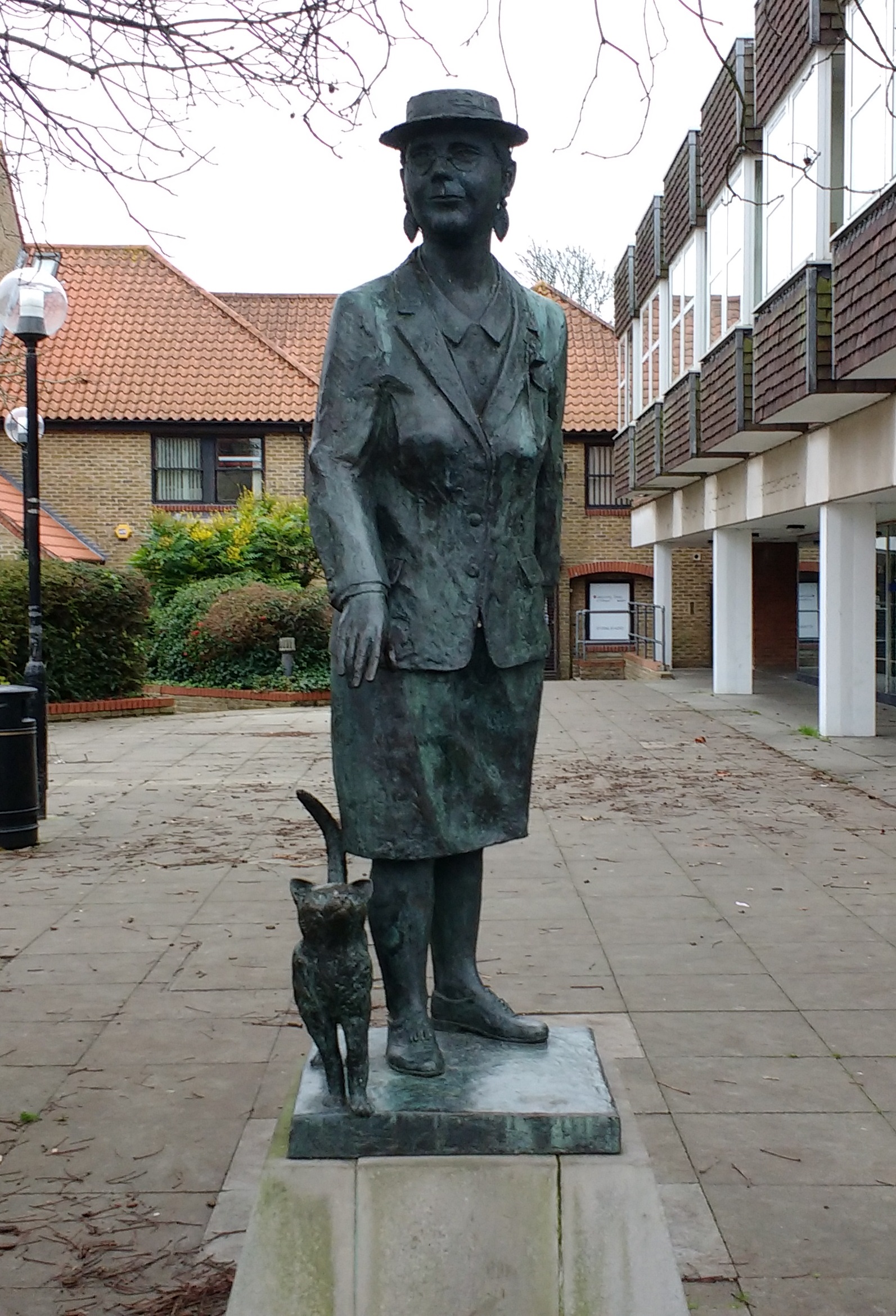
Bronze statue of Dorothy L. Sayers, by John Doubleday. Located on Newland Street, Witham, England.
The purpose of the Faith@Work Summit is to gather active participants and leaders in the faith at work movement from every industry sector to learn from each other and work together to extend Christ’s transforming presence in workplaces around the world. The next Summit will be in Chicago on Oct. 11-13, 2018. Go to fwsummit.org to sign up for updates and to learn more about the Summit.
Dorothy Sayers’ “Why Work” is often cited as a crucial faith and work movement text. Below, Mark Greene gives a moving tribute to Sayers’ life and writings at the 2016 meeting in Dallas.
P.S. Soon we hope to have a review of the book The Artist and the Trinityby Christine Fletcher on Sayers’ theology of work posted here at TGR!
By Alistair Mackenzie (see our interview with Alistair here) Previous posts in this series: Part 1, Part 2, Part 3, Part 4 Theses are by their nature pretty academic documents and it wasn’t long before some friends of mine who were mostly business people started to say to me, “Hey Alistair are you ever going to bring some of these high-flown ideas down to…
“The American ideal of racial progress is measured by how fast I become white.” James Baldwin As a white person I’ve never been very cognizant of my complexion—I’ve always just blended in; in my white family, my white neighborhoods, my white college, my white workplaces, and my white churches. It’s never been a matter of reflection because it’s all seemed…
By Tim Chester, reprinted from his blog under a Creative Commons 3.0 license. Christians in the West today increasingly finds ourselves living on the margins. It was the same for the readers of 1 Peter. In a series of posts I’m identifying principles from 1 Peter for developing a gospel and missional DNA in our churches. Here are the four principles: Proclaim the…
MLK’s famous image of a street sweeper, widely familiar in the faith and work movement, is at the center of an profound talk he gave six months before he was murdered, on discerning “your life’s blueprint.” In that talk, he enumerates three elements of a sound blueprint for a human life. With this second post in the series, we come to the second element, the one that most clearly connects work to the metaphor of a blueprint.
We have already seen that the first element in the blueprint of a good life is the dignity of the human person, concerning which MLK draws on the tradition of Christian personalism. This element is the foundation of the building – the blueprint. The other elements of life go wrong when they’re not building on human dignity in this way.
Second on his list of three elements for a sound blueprint is to strive for excellence in all you do:
Secondly, in your life’s blueprint you must have as the basic principle the determination to achieve excellence in your various fields of endeavor. You’re going to be deciding as the days, as the years unfold what you will do in life — what your life’s work will be. Set out to do it well.
In a moment, he is going to connect this issue to questions of justice and particularly to the role of injustice in economic systems. That is a big enough issue, however, that I want to hold off and cover it in full with the following post.
Before we get there, first I want to connect this call to excellence to something that comes earlier in the talk. The way he describes the metaphor of a blueprint for life has always struck me as profound:
Whenever a building is constructed, you usually have an architect who draws a blueprint, and that blueprint serves as the pattern, as the guide, and a building is not well erected without a good, solid blueprint.
What has struck me in the past is the role of the “architect.” If there is a blueprint, there is an architect.
And King is not suggesting to the middle-school students in the audience that they design their own blueprints – that they are the architects of their own lives. On the contrary, he is there primarily to speak to them about what the blueprint for their lives contains. The question is whether they will build their lives according to the blueprint; the blueprint itself has already been drawn up!
We are the builders of our lives, but not the architects. This is, of course, the key difference between a religious and a secular view of human life.
What strikes me now, revisiting this passage, is the image of life’s blueprint as an excellent work that guides us into excellent work. The blueprint is our “pattern” and “guide,” so the building can be “well erected” only if the blueprint is “good,” “solid” and (just a bit later) “proper” and “sound.”
We are able to do excellent work because we are ourselves an excellent work.
This is not an arbitrary or coincidental verbal connection. A standard of excellence is inherent in a religious view of human life. God is not simply there to provide rules we must obey; that could be a deistic view of life, but not a religious one. Mere intellectual belief in a deity becomes religion when worship is involved, and if worship is to be more than merely obeisance before power, it must involve reverence for the excellence (truth, beauty, goodness) of the deity. “Taste and see that the Lord is good!”
And because we tend to become what we worship, when we revere the excellence of the creator we also strive for excellence in our own creative work. The image of a blueprint conveys this with precision. God’s excellent work in making us is the guide and pattern for excellence in our own work.
The first element flows naturally into the second because the call to excellence is an essential correlary to the proposition of human dignity. When the concept of human dignity is cut off from its roots in God’s excellence, as it has been in our civilization, it becomes inflated beyond measure. As we noted last time, the faith and work movement today spends a lot of time dealing with narcissism among people who have an inflated sense of their own human dignity; that is what happens when we talk about human dignity without talking about a creator and a vocation to excellence for his creations.
In an unfallen world, we would pass very easily from human dignity to a call to excellence to King’s third element, in which these reach their fruition. However, since the fall we have had to take a lot of complex detours. These include, as we have seen, distorted views of human dignity and, of course, distorted views of what counts as excellence.
King naturally chooses to focus on something else – the failure of economic systems to recognize and reward good work done by the marginalized. We will turn to that in the next post.
Steve Garber is the director of the Master of Arts in Leadership, Theology, and Society at Regent College in Vancouver, BC, and Professor of Marketplace Theology. He came to Regent from his work as the founder and director at the Washington Institute for Faith, Vocation, and Culture. Steve is the author of The Fabric of Faithfulness, Visions of Vocation, and…








 By Greg Forster; part two of a
 The Green Room