
Reprinted from Made to Flourish. Check out their resource library here. What does it take to revive a dying city? That’s the question Fairhaven Church faced in 2008, when Forbes magazine named Dayton, Ohio, as one of the fastest dying cities in America. After the article was published, we interviewed the mayors of Dayton and neighboring cities, and we discovered the greatest…
Category: Integration with the Church

Book Review – The New Copernicans: Millennials and the Survival of the Church
I am excited to introduce you to a book that, while not a faith and work book, has serious implications for the future of the faith and work movement, John Seel’s The New Copernicans: Millennials and the Survival of the Church. I realize that is a strong statement; please read on. John is a cultural renewal entrepreneur and social impact consultant. He…
Vocational Sacraments
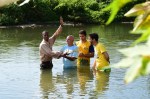
Part one of a series. Jenn Woodruff Tait is right that one of the biggest theological lacunae in the movement is our inattention to the sacraments. Having already written a post for this blog entitled “Let’s Bicker about Eschatology!“, naturally if Jenn invites me to bicker about the sacraments my only response is: “Challenge Accepted!” So here’s a blog series…

How One Church Launched 11 Social Ventures
It’s a late spring day in St. Paul, Minnesota, and I’m standing in front of the Ravoux high rise apartments, a public housing project. When a bright, multicolored bus pulls into the complex, the waiting crowd outside includes several residents. The Twin Cities Mobile Market has arrived. For the past two years, this grocery-store-on-wheels stops at Ravoux every Friday at noon, bringing…

What’s the Matter With Anglicans? A Response to Greg Forster
Recently, Greg Forster addressed in this space the question of whether or not the faith and work movement is overrun by Reformed folks, or at least by their theology. His answer surprised me. He thinks the answer is “no.” Greg actually says a lot of great things in that post which I agree with, but his contention that the theological leadership…

My Faith and Work Journey (Part 6)
By Alistair Mackenzie (see our interview with Alistair here) Previous posts in this series: Part 1, Part 2, Part 3, Part 4, Part 5 There were a number of specifically faith-related responses that surfaced frequently in my survey work, including: All Christians equal, but some more equal. Regularly I heard comments that amounted to something about all Christians being equal, but those involved in “full-time…
Karam Forum 2018: Poets and Prophets for God’s People and World
Charlie Self delivered the closing address at Karam Forum 2018, “Poets and Prophets for God’s People and World.” He cast a vision for theological and educational institutions to raise up Christians who can inspire and instruct in a polarized and embattled world. In seeking the shalom of the church and the nations, our institutions of higher learning will find their own shalom – a path out of their present troubles.
If you enjoy this talk, mark your calendars to join Miroslav Volf, David Miller and more at Karam Forum 2019!
Self opened his address with the story of a church that sought unity in the midst of Election 2016 by having local leaders from both political parties serve the Eucharist to one another and the congregation. Christian leaders contribute to local economic development, scholarly knowledge and much more by serving as poets and prophets of the kingdom.
Our world is facing two crises of paramount importance, Self observed. There is a crisis of anthropology, as the world forgets that human beings are made in God’s image. And there is a crisis of epistemology, as the world struggles for coherence and certainty amid the wreckage of worldly philosophies in both modern and postmodern movements.
The answer lies in whole-life discipleship – which, Self pointed out, is actually a redundant phrase. “Whole-life discipleship” is simply discipleship, because our God made and cares for all aspects of life. Living as disciples of Christ empowers us to “live the future now,” bringing a foretaste of the future consummation in to the present. “Connecting Sunday’s ecstasies to Monday’s ethics is of paramount importance,” he remarked.
Our theological schools strive to provide an “eschatological education” for this life, which is what sets them apart from departments of religious studies. Overcoming the mental and practical bifurcation that prevailed during the Enlightenment, privatizing religion, we integrate knowledge and take on tough issues from the standpoint of God’s present reign – and an awareness of our own limitaitons.
This integrative intellectual mission entails a role of “worldview leadership to the larger world.” We are able to think about the challenges of our time free from captivity to political and ideological polarization. Without common moral commitments or shared narratives, the world around us becomes less and less able to think outside its comfortable but ultimately enslaving mental boxes. Christian higher education can lead the way to fresh insights in such an environment.
With an abundance of examples and illustrations, Self showed how we can raise up poets and prophets to serve God’s people and God’s world. As poets, we discover the ways of life and worldview in the Bible, distill its insights with the help of history and the Holy Spirit in community, and disseminate them contextually and creatively. As prophets, we faithfully call people back to the principles and praxis of the covenant, stand fearlessly against idolatry, immorality and injustice, and provide visions of the future – ultimate, but also penultimate and culturally contextualized – in which God reigns.
Institutions are part of God’s plan, and Christian higher education has a tradition of innovation that can be called forth in our own efforts to steward the knowledge tradition handed down to us: “From the desert fathers to the Irish monks, from the early universities to our modern Bible colleges, God’s people have always preserved more than mere practical knowledge. We have a deposit of scriptural truth, and a deposit, providentially, of the truth of other sciences, and we’ve preserved it when the economies are up, when they’re down – because it matters, in the character and content of what we bring to the world.”
Reprinted from the Oikonomia Network
Church-Nonprofit Partnership Proves a Godsend for Struggling Outreach Ministry
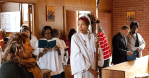
A priest and his congregation reached out to the community to help save their popular after-school literacy program. Reprinted from Faith & Leadership. Almost every church person I know has been overextended at one time or another, taking on far more than they can handle. We used to call it “having too much on your plate.” But just as individuals…
Vocational Faithfulness as Public Discipleship: A Video from the 2016 Faith at Work Dallas Summit
The purpose of the Faith@Work Summit is to gather active participants and leaders in the faith at work movement from every industry sector to learn from each other and work together to extend Christ’s transforming presence in workplaces around the world. The next Summit will be in Chicago on Oct. 11-13, 2018. Go to fwsummit.org to sign up for updates and to learn more about the Summit. Register for the Summit here!
Vocational faithfulness is not only about individual character but also about applying a biblical-theological lens to the work of the institution in which one labors. (“Institution” here refers to the social sector in which the organization where one works is situated.) We are called to image-bearing in our vocational sectors, which involves practices of both personal discipleship (e.g., prayer, functional dependency on the Spirit) and public discipleship (in love, advancing justice and shalom for the common good).
The public expression of vocational image-bearing is at least threefold:
- Cultivating within the vocational sector all its creational intent and possibilities; aligning it with what it “was meant to be” in God’s original design
- Restoring the sector to righteousness (“set-right-ness”) where it has been corrupted
- Imagining the work of this sector in “the age to come” and offering a foretaste of those future Kingdom realities now
REFLECT & RESPOND
1. Most vocational expressions of public discipleship have focused on white-collar professionals. In what ways can/do blue-collar workers bear Christ’s image for the common good?
2. One way of “going deeper” in vocational faithfulness is the progression from individual to institutional thinking. What other shifts or progressions mark a “2.0” understanding of “faithful presence” in various vocational sectors?
Dr. Amy L. Sherman, a Senior Fellow at the Sagamore Institute, was named by Christianity Today in 2012 as one of the 50 evangelical women most influencing the American church and culture. She’s the author of six books and over 80 articles in periodicals including First Things, The Public Interest, The Christian Century, Christianity Today, and Books & Culture. Her most recent book is Kingdom Calling. You can read a reflection on her talk at TGR here.

Being White in the (White) Faith and Work Movement, Part 2
A few weeks ago I wrote about being a white guy in the faith and work movement, which is also predominantly white. After reviewing the many layers of white leaders, participants, authors, directors, and founders in the movement, I suggested that the faith and work message is in dire need of some more input. Because our movement is demographically narrow,…
 The Green Room