Ever heard of a “green room”? It’s the room in a theater where actors and speakers can relax when they’re not on stage….talk to each other about what they really think, fix their makeup, get some coffee, and otherwise prepare for their next moment “on.”
Well, this blog is the green room for the faith and work movement, where its leaders can kick off their shoes, grab a cup of coffee or a mug of tea, and talk heart-to-heart about where the movement’s come from, where it’s going, what’s working, and what’s not working. We hope you’ll join the conversation.
By Tim Chester, reprinted from his blog under a Creative Commons 3.0 license. Missional community life and everyday church requires a certain level of proximity. I’ve had a lot of questions on this issue, especially when I’ve been in the United States. Let’s take a church I spent some time with in New Jersey as an example. They have people…
We’re very excited to release our latest EWP Talk: Andy Crouch’s brief but powerful address at Karam Forum 2018. Drawing on the imagery of Isaiah 5, Crouch spoke about the challenge of separating real flourishing from transitory prosperity in the midst of economic growth and technological innovation. In a world where we can have instant gratification in so many ways, what is of lasting importance?
“If you want to have a biblical conversation about flourishing, you are going to end up – sooner or later – at the story of the vineyard,” said Crouch. The image of Israel as the Lord’s vineyard, most fully developed in Isaiah 5 but recurring in many other places as well, contains a wealth of potential insight that speaks to the present state of our own civilizations and cultures.
Like us, the Israelites were prosperous. But the story of Isaiah 5 is not a happy one. The vineyard produces “wild grapes,” which explode with seeming abundance, but aren’t properly tended and don’t last. Crouch compares worldly prosperity built on fragile foundations to sidewalk chalk art in the tradition of trompe l’oeil (“deceive the eye”). It isn’t what it appears to be; take one step to the side and the illusion disappears.
And it’s doomed to be washed away in the next rain. The Lord wants flourishing from his world, Crouch points out, so if we don’t pursue real flourishing we can be sure our efforts will ultimately fall apart.
The point is not that economic success is bad; the point is that we need to change our definition of what counts as economic success. We tend to seek out activities and accomplishments that are “low friction” – that involve less investment and provide a shortcut to enjoyable experiences. But low-friction activities are by their nature unstable; precisely because the barriers are low, today’s quick fix is quickly replaced by tomorrow’s quicker fix. Crouch points to the music industry, which is contracting rapidly because access to recorded music has become effectively free.
What are we producing that is worth preserving? Crouch suggests that while the Bible does not have a “prosperity gospel,” it does have a “posterity gospel” – it calls us to prioritize what kind of world, what kind of culture and what kind of civilization we leave for our grandchildren. We should invest in things that are worth passing on.
The flourishing life is a pruned life. The Lord prunes his vineyard and it flourishes sustainably.
And the irony is that once we accept the pruned life, the massive power and wealth of modern markets become tools we can use to accomplish the Lord’s purposes. An internet-based music community allows musicians to collaborate digitally and produce art that is superior to what the major labels produce. Crouch even points to fast-food restaurants like In-N-Out and Chik-Fil-A, which have been built on serious and worthy visions of what a fast-food restaurant ought to be like. It is people – from the CEO to the fry cook – who live the pruned life who produce and sustain such visions of flourishing.
“This is where the church needs to be,” concludes Crouch, “going to every part of the world of mere affluence and turning it into a vineyard.”
by Fletcher Lowe During my sophomore year in college, I got a note from the Dean of Students to come to his office!! UGH! What had I done to warrant that? So, dutifully and a bit nervously, I came at the appointed time and was ushered in. The Dean asked me to sit down, and then asked me a…
The 2018 Faith at Work Summit, held in Chicago at the Hyatt Regency O’Hare on October 11th-13th, is now open for registration! The early bird pricing for registration is now available at $179 per ticket, so be sure to purchase soon! Speakers at the Summit include a wide range of marketplace leaders, pastors, and Christian educators, including Katherine Leary Alsdorf, Sandra Ricther, Tommy Lee, Mark Greene, Missy Wallace, Andy…
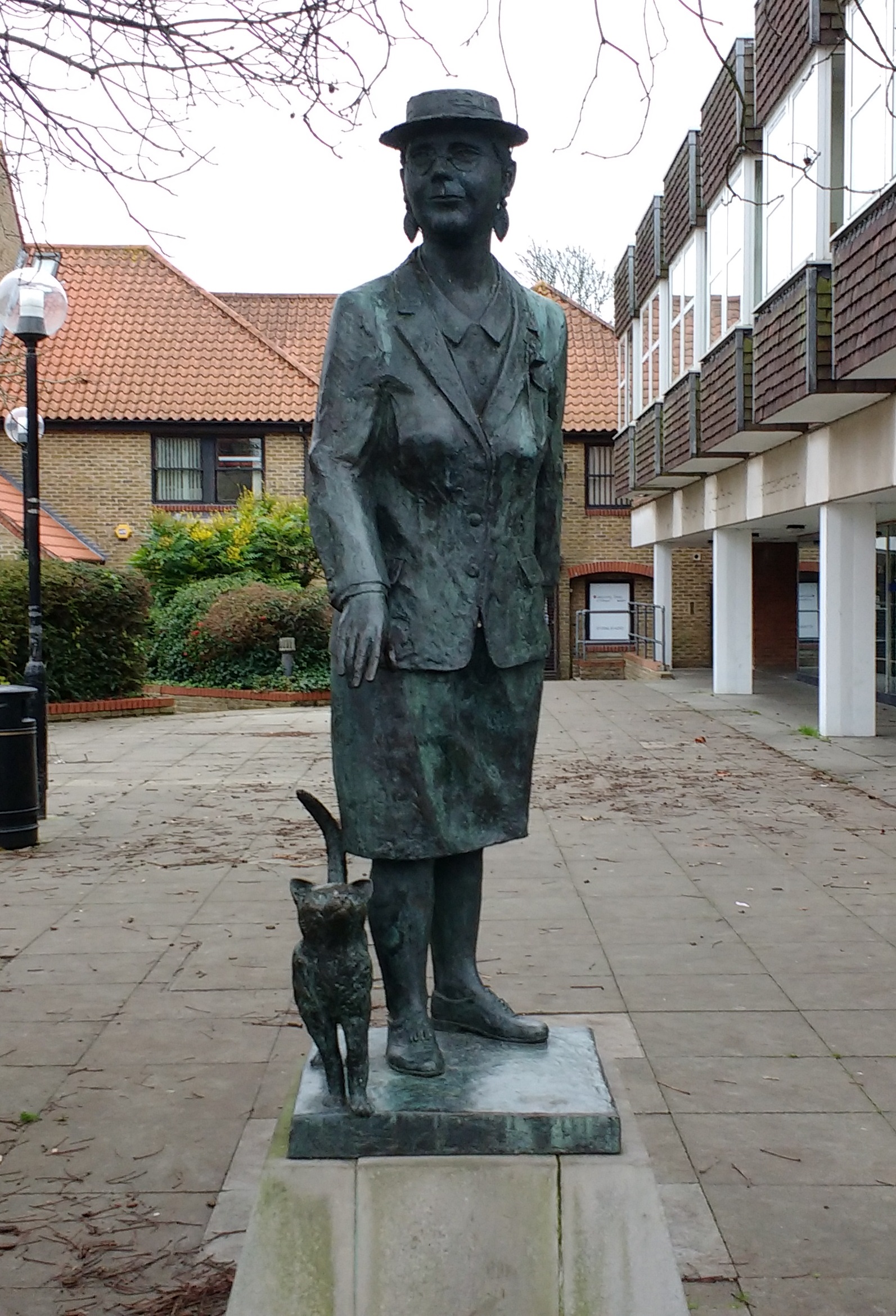
Bronze statue of Dorothy L. Sayers, by John Doubleday. Located on Newland Street, Witham, England.
The purpose of the Faith@Work Summit is to gather active participants and leaders in the faith at work movement from every industry sector to learn from each other and work together to extend Christ’s transforming presence in workplaces around the world. The next Summit will be in Chicago on Oct. 11-13, 2018. Go to fwsummit.org to sign up for updates and to learn more about the Summit.
Dorothy Sayers’ “Why Work” is often cited as a crucial faith and work movement text. Below, Mark Greene gives a moving tribute to Sayers’ life and writings at the 2016 meeting in Dallas.
P.S. Soon we hope to have a review of the book The Artist and the Trinityby Christine Fletcher on Sayers’ theology of work posted here at TGR!
By Tim Chester, reprinted from his blog under a Creative Commons 3.0 license. Christians in the West today increasingly finds ourselves living on the margins. It was the same for the readers of 1 Peter. In a series of posts I’m identifying principles from 1 Peter for developing a gospel and missional DNA in our churches. Here are the four principles: Proclaim the…
Steve Garber is the director of the Master of Arts in Leadership, Theology, and Society at Regent College in Vancouver, BC, and Professor of Marketplace Theology. He came to Regent from his work as the founder and director at the Washington Institute for Faith, Vocation, and Culture. Steve is the author of The Fabric of Faithfulness, Visions of Vocation, and…
The purpose of the Faith@Work Summit is to gather active participants and leaders in the faith at work movement from every industry sector to learn from each other and work together to extend Christ’s transforming presence in workplaces around the world. The next Summit will be in Chicago on Oct. 11-13, 2018. Go to fwsummit.org to sign up for updates and to learn more about the Summit.
In one of the opening talks at the 2014 Boston Faith@Work Summit , Greg Forster talked about economics…and teddy bears. Why teddy bears? Learn more below!
Lee Vinsel is Assistant Professor of Science, Technology, and Society at Virginia Tech and one of the conveners of The Maintainers, a global, interdisciplinary research network made up of those who are interested in “the concepts of maintenance, infrastructure, repair, and the myriad forms of labor and expertise that sustain our human-built world.” TGR: What led you to begin the…
by Fletcher Lowe As I sat in the dentist’s chair somewhat anxious (isn’t that what most of us feel!) awaiting the dentist, I began a conversation with the hygienist. She spoke about how much she loved what she did, how fulfilling it was. I said, “Sounds like you have a real ministry here.” She paused and said, “I never thought…







 The Green Room