
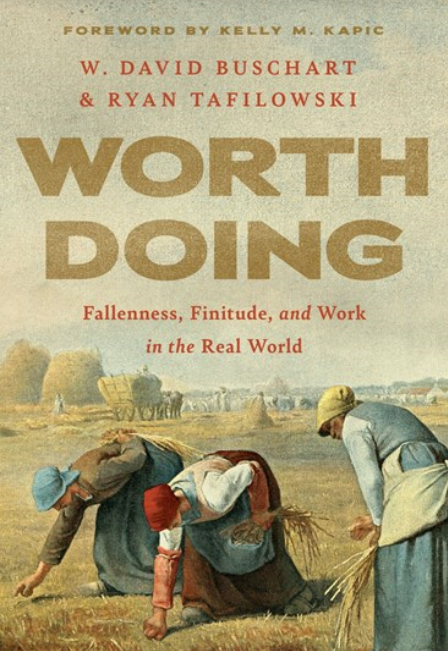
 By now it is almost a truism that the faith and work movement struggles with reaching blue collar workers. A number of very smart people have tried to do something about that. More than any I have seen so far, W. David Buschart and Ryan Tafilowski have succeeded with their new book Worth Doing: Fallenness, Finitude, and Work in the Real World. Or, at the very least, they have given the rest of us a methodological scaffolding on which to stand while we try.
The reason why this book succeeds where others have perhaps failed, or at least not gone as far, is that it dares, explicitly and centrally, to question another truism of the faith and work movement – in its evangelical form, at least: the four-chapter gospel. By now, many readers of this blog could probably repeat this gospel in their sleep: creation, fall, redemption, consummation.
Many efforts at getting people to realize that their work matters to God have centered on creation: God did not give work to us as a punishment after the fall, but designed it as part of the way he originally wanted the world to operate. And these efforts have also focused on consummation: someday, in the new heaven and in the new earth, we will not lie around playing harps all day but will once more work in the ways God intended. Tell people about the initial and final beauty of work, the thinking goes, and they will see the nobility in their daily tasks.
Buschart and Tafilowski have taken one look at that common line of thinking and said: Wait a minute. “Though we have been told about chapter one,” they say, “none of us have ever experienced it, and though we’ve heard rumours of chapter four, none of us have ever seen it” (5-6). (In the words of a quote I read many years ago and have lost the source for, originally regarding post-Vatican-II liturgical reform, “We have to start where we are, not where we were. We aren’t there anymore.”) Buschart and Tafilowski argue that “any realistic theology of work” will have to deal with both human finitude and human sin: “the experience of the majority of workers reflects Genesis 3, not Genesis 1-2” (6). Or, as a book I reviewed for this blog some years ago argued: Work, at least as we currently experience it, sucks.
I have read a lot of books which make the argument that work sucks over the past twelve years of my life in the faith and work movement. Up until this moment, all of them have been secular, and not simply secular but either implicitly or explicitly Marxist. This one is not. It notes all the same critiques of work as we experience it in a fallen world that a Marxist book would make – all the ways in which modern work so deeply troubles a lot of modern workers, whether blue collar or white collar or pink collar – and it roots every last one of them in Christian theology.
Dearest gentle reader, I just about fell off my chair.
Of course, the point of this book as a faith and work theology is to express a Christian hope that a Marxist book would not express. And Buschart and Tafilowski do this. But they do it while remaining in a Genesis 3 world. To do so, they wrestle heavily with the concept of finitude.
First, in a chapter called “Good,” they develop the many ways in which humans are in fact created to be finite. We can only be in one place at one time, and we are all physically, emotionally, and intellectually limited in various ways. These finitudes leave us dependent on an omniscient, omnipresent, all-knowing and all-powerful God – and on our neighbors and the created order – and this is a good thing: “Very strictly speaking, the finitudes are not in and of themselves the gift. The gifts ultimately reside in the relationships” (53).
But, as they next argue in a chapter called “Enough,” “finitude does not need to be either eliminated or redeemed for work to be good” (55) even though, “due in no small part to finitude, work can be a challenge, unpleasant, and it can require us to do things we don’t want to do” (58). “Enough” explains at length why work often sucks because of situations where finitude is not being respected. For a CEO with a great degree of agency, this may mean that the CEO is a workaholic not respecting their own finitude. For those in the trenches, whatever color their collar, this may mean that those who guide and supervise the trench work are not respecting trench-workers’ finitude. (Often these two problems are related, of course).
So if finitude is not sin, what role does sin play in all this? In “A View From the Middle,” Buschart and Tafilowski explore three ways sin also makes work suck: enmity, absurdity, and tragedy. This paragraph is worth quoting in full:
. . .enmity, absurdity, and tragedy are the three heads of the Hydra that tend to sprout wherever humans undertake their work. A young professional grinding himself to dust out of a relentless ambition to make partner at his firm, which inevitably involves bitter competition with his peers, knows from experience how a wrongly ordered view of work thwarts his own flourishing, even if he cannot acknowledge it fully. A low-level employee entering data into a spreadsheet that literally no one else will ever see or use knows from experience how absurd work can be. An advertising executive who feels pangs of conscience while crafting a marketing strategy for a global corporation that exploits cheap, unregulated labor does not need to read Augustine to sense her tragic implication in this state of affairs (101).
Then, in “Toil and Trouble” and “The Goodness of Finite and Fallen Work,” Buschart and Tafilowski use this framework to describe work in a Genesis 3 world through “naming, diagnosing, and addressing idolatrous or self-aggrandizing work (enmity), futile or pointless work (absurdity), and grotesque, unjust, or alienating work (tragedy),” while being clear that in that Genesis 3 world any solutions will be “proximate, partial, and unsatisfactory” (121).
In so doing, they question another faith and work movement truism, this one about the Reformation’s influence on dignifying ordinary labor. They argue that the Reformation’s “radical recovery of the priesthood of all believers” (124), while a good thing in itself, has – or at least the “mutation” of it in the contemporary faith and work movement has – “over-activat[ed]” a “homo faber (‘man as builder’) model of the image of God, almost always identifying the imago Dei with the capacity to co-create with God” (124).
Once we took this methodological turn, Buschart and Tafilowski argue, we have failed to recognize in the “agency-dignity-power” narrative which most modern faith and work literature puts forth that “while humans are still to fulfill the cultural mandate entrusted to them in Genesis 2, the conditions under which they must do so have deteriorated irreversibly” (126). As they later note, “The agency-dignity-power narrative works well for those whose work is creative and satisfying: it is less clear whether these ideas help people whose work is degrading or unfulfilling” (192) – especially if those people, for reasons of sin or finitude, cannot change that situation. (It’s clear from this part of the book that Buschart and Tafilowski have read a lot of the same proto-Marxist books I have, and that they agree with the diagnoses, if not the solutions.)
In order to identify work as good under these conditions, one last faith and work movement truism must be questioned:
In sum, an account of work that is not only theologically sound but also thoroughly biblical will need to recover an instrumental view of work as a tool in our pastoral toolkits, which can supplement (but not replace) an intrinsic view of work. Such a recovery is vital, we argue, if the faith and work movement is going to speak to a broader range of workers, all of whom toil in the middle, having heard only a rumor of Eden and not yet at the open gates of the new Jerusalem. . .Put another way, a realistic theology of work will put work in proper perspective: a penultimate reality that can be good and purposeful but also futile and fruitless, but in neither case salvific in any ultimate sense in and of itself. Otherwise, we run the risk of freighting our jobs with existential weight they simply cannot bear. . . Sometimes a job is just a job – and jobs are still worth doing (183, 193).
This may require questioning theoreticians that the movement has until now held dear, the authors maintain; a few are mentioned, but I’ll let you read the book yourself to discover who. It may also require (I would add) amplifying the voices of those who are already making similar points (and Buschart and Tafilowski do bring up several of them throughout the book).
This is an incredibly important book. (And though this already-overlong review hasn’t even touched on this yet, Buschart and Tafilowski bring extensive Scriptural, theological, and historical receipts at every moment to back up even the most controversial of their points.) It is also incredibly dense and full of technical theological language (as a lowly historian I had to look up what “protology” was), language which alternates with periodic moments of absolute rhetorical mike drops. For that reason, it may be a book for the academy rather than the practitioner, at least swallowed whole. But faith and work academicians absolutely need to wrestle with it, and we practitioners need to take seriously what they have to say.
These critiques of what we are about have been made by the secular academy for at least a generation (longer, honestly, if you want to open up the can of worms that going back to Max Weber entails). Now the call is coming from inside the house. Are we going to answer?
 The Green Room