
By Greg Forster, reprinted from the Oikonomia Network.
The Economic Wisdom Project is best known for our Economic Wisdom Project Talks, which are short, accessible, engaging and rich presentations suitable for use in classrooms and group discussions. But the EWP also features print resources, including our vision paper and our twelve elements of economic wisdom.
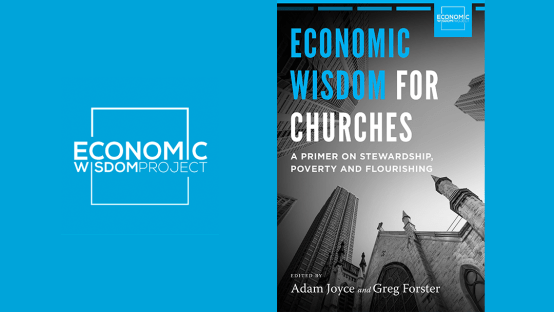
Economic Wisdom for Churches, our EWP book, is a small volume that packs a big punch. It features essays for local church leaders on critical issues facing their churches by Amy Sherman, Scott Rae, Tom Nelson, Charlie Self, Zachary Ritvalsky, James Thobaben, Jay Slocum, Jordan Ballor, Greg Forster and more. The essays are short and accessible enough to read through quickly, but offer the depth and insight to reframe the challenges churches are facing in their communities, overcome the paralysis of our polarized society, and bring the holy love of God out into our world.
The eBook is available for purchase from Amazon. For hard copies, contact us.
Below is an excerpt from a chapter in Economic Wisdom for Churches. Citations have been omitted.
Opportunity: What Does Justice Require?
Greg Forster
THESIS 50: Christians should be taught that if the pope knew about the exploitation practiced by the indulgence-preachers, he would burn the church of St. Peter to ashes rather than build it with the skin, flesh and bones of the sheep.
Martin Luther, 95 Theses
Jobs, poverty, globalization, environment, debt, racism, trade – does the church have anything to say about these matters, of such vital concern to the people around us? I believe that pastors today do not lack the will to speak about justice; rather, our challenge is to find language pastors can use with confidence, a way of bearing witness for justice that does not make the church captive to partisan or ideological agendas. While justice is complex, I argue that expanding opportunity provides one valuable organizing concept for economic justice that allows us to bring together theological integrity and contemporary applicability….
Christian Transformation of Economics: Image, Incarnation and Redemption
Christianity carried to all nations an alternative to the [pagan] dualistic mindset, one that God had been building up among the Israelites for centuries. The theology, anthropology, ethics and sociology of the Old Testament – especially in the goodness of creation, the central role of work in the purpose of human life, the integration of body and soul in human personhood, and the integration of the material and spiritual in social life – equipped Christianity to challenge dualism comprehensively.
Stimulate insight and engage students by assigning one of our exciting and catalytic EWP Talks! Keith Reeves on Family and Opportunity in the Old Testament:
Even more radically, Christianity challenged dualism through the doctrine of the Incarnation. God not only became a man, but actually arranges his relationship to the whole human race and the entire created order through actions he accomplished within time/space history. This compels a total reorganization of our conceptions of how time and eternity, being and becoming, matter and meaning relate to one another. Dualism was challenged at its deepest roots.
For a civilization influenced by Christianity, the fundamental economic fact is not that people have material needs, but that they have creative talents – and a calling to serve others with those talents (Matthew 25:14-46, Luke 19:1-27, Ephesians 2:10). God owns and has dominion over the entire created order, and he has appointed human beings to serve as his stewards, calling them to use this responsibility to cultivate and protect creation by blessing one another. All are therefore responsible to God for the productive cultivation and protection of whatever portion of creation comes under their care. This responsibility should be central to each person’s identity and the structure of all life activities.
The calling to fruitfully serve other people’s needs makes all legitimate work intrinsically meaningful and breaks down the dualistic division between meaning and materiality. The fact that work is something human beings do is not nearly as important as the fact that they do it for one another. Economic workers participate directly in the system of meaning as they strive to do their jobs well and productively serve the needs of others – provided that service to others is their motivation.
Greg Forster on bringing life to the modern economy:
By the work of redemption, applied to us by the Holy Spirit, Christ restores in us this vision of human flourishing, grounded in the image of God. The gospel that restores us to righteousness in God’s sight and secures our eternal future also transforms the way we live in the present through our union with Christ. Eternal life does not begin at death; eternal life is a new kind of life that we begin living now.
This is why so many of the heroes of the faith throughout church history have made justice for the poor and the oppressed central to their gospel witness…
To read more, purchase Economic Wisdom for Churches.
 The Green Room