
By Victor Claar, reprinted from the Oikonomia Network.
The Economic Wisdom Project is best known for our Economic Wisdom Project Talks, which are short, accessible, engaging and rich presentations suitable for use in classrooms and group discussions. But the EWP also features print resources, including our vision paper and our twelve elements of economic wisdom.
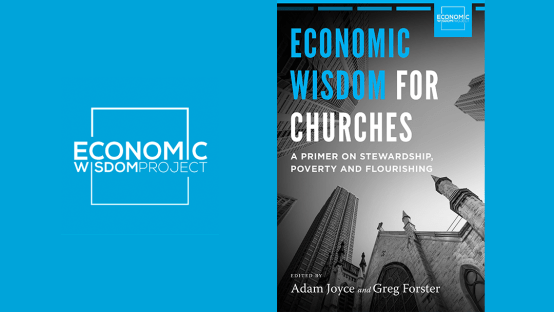
Economic Wisdom for Churches, our EWP book, is a small volume that packs a big punch. It features essays for local church leaders on critical issues facing their churches by Amy Sherman, Scott Rae, Tom Nelson, Charlie Self, Zachary Ritvalsky, James Thobaben, Jay Slocum, Jordan Ballor, Greg Forster and more. The essays are short and accessible enough to read through quickly, but offer the depth and insight to reframe the challenges churches are facing in their communities, overcome the paralysis of our polarized society, and bring the holy love of God out into our world.
The eBook is available for purchase from Amazon. For hard copies, contact us.
Below is an excerpt from a chapter in Economic Wisdom for Churches. Citations have been omitted.
Value Creation: What Do We Contribute?
Victor Claar
If we want to think about how we create value for each other, we should not just think about our work. Believe it or not, when it comes to value creation, the exchange of goods and services – buying, selling, and swapping them – is just as important as the work that creates the goods and services. We can’t really understand work if we don’t understand the systems of exchange through which we serve each other with our work.
What You Can Learn at a Swap Meet
I grew up in western Pennsylvania. By the time I graduated from high school, I was blessed to have lived in just two towns: Portage and Punxsutawney. I say “blessed” because my father served as a Methodist minister in the Western Pennsylvania Conference, and, due to the Methodist itinerancy system, cases like mine – in which a child could live in one town for nine years at a time – were rare.
Stimulate insight and engage students by assigning one of our exciting and catalytic EWP Talks! Andy Crouch on Isaiah’s “Posterity Gospel”:
While living in Punxsutawney, one of the highlights of my summer vacation each year was attending Seneca Hills Bible Camp, a retreat center located outside of Franklin – not far from the site where, in 1859, George Bissell and Edwin L. Drake erected the first successful oil rig in the United States. After completing fourth grade, I attended and worked at Seneca Hills each summer until I graduated from high school. I have carried its motto, That I May Know Him, and a song with the same name, with me throughout my life. Based on Philippians 3:10, the song goes:
That I may know him
who died for me.
That I may know him
who set me free.
One day he’s coming:
What victory,
that I may know him eternally!
While I enjoyed the teaching and fellowship at each summer session I attended, one of my fondest memories involves a community of exchange. During senior high week each year, young men and women from throughout Pennsylvania, Ohio, and West Virginia converged upon Seneca Hills. In their suitcases, they brought rare, exotic treasures from their homelands: graphic t-shirts.
Teenagers of almost every generation have enjoyed cool t-shirts. But in the early 1980s, you had to settle for the shirts you could find in your town’s brick-and-mortar stores. There was no eBay, not even an Internet; even direct-mail marketing was still mostly limited to catalogs like Sears and Montgomery Ward, both nearly a century old by then. Such circumstances made it difficult – if not impossible – for teenagers to acquire t-shirts that their peers at home had not seen before. You might be fortunate enough to be given a shirt by your relatives upon their return from a family vacation, but even with the best of intentions, your relatives probably wouldn’t bring you a shirt you would want to wear to school.
Seneca Hills was different.
Jennifer Woodruff Tait, Charlie Self and Jay Moon on the Industrial Revolution and the Wesleyan movement:
The t-shirt trading started small. A few of us who had been working at Seneca throughout the summer were already trading among ourselves. We were happy with the trades. But our opportunities were limited because we had so few trading partners. In short, if we wanted better t-shirts, we needed to expand our trading universe.
When senior high week arrived, we mainly relied on word-of-mouth to spread the when and where of the “swap meet.” Campers were encouraged to come and potentially trade their ho-hum t-shirts for something a bit more exciting, something new.
To read more, purchase Economic Wisdom for Churches.
 The Green Room