
By Jordan Ballor, reprinted from the Oikonomia Network.
The Economic Wisdom Project is best known for our Economic Wisdom Project Talks, which are short, accessible, engaging and rich presentations suitable for use in classrooms and group discussions. But the EWP also features print resources, including our vision paper and our twelve elements of economic wisdom.
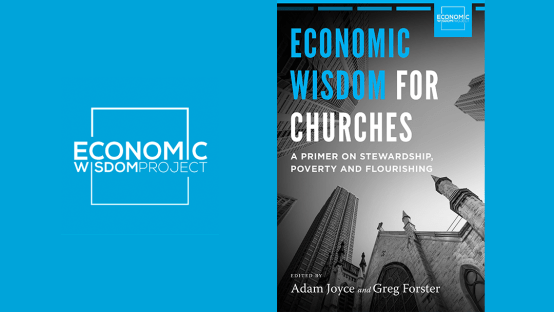
Economic Wisdom for Churches, our EWP book, is a small volume that packs a big punch. It features essays for local church leaders on critical issues facing their churches by Amy Sherman, Scott Rae, Tom Nelson, Charlie Self, Zachary Ritvalsky, James Thobaben, Jay Slocum, Jordan Ballor, Greg Forster and more. The essays are short and accessible enough to read through quickly, but offer the depth and insight to reframe the challenges churches are facing in their communities, overcome the paralysis of our polarized society, and bring the holy love of God out into our world.
The eBook is available for purchase from Amazon. For hard copies, contact us.
Below is an excerpt from a chapter in Economic Wisdom for Churches. Citations have been omitted.
Economic Value: What Should We Want?
Jordan Ballor
Markets are great at giving us what we want, but what should we want? Economists have an unfortunate tendency to idolize consumer desires, treating them as self-legitimizing. Whatever people want, it’s good for markets to satisfy those desires. Economic flourishing simply means more and more consumer desires being satisfied.
We do need markets to accomplish most of the good things that we legitimately want. But we also need to resist the idolization of desire. We need to find objective standards that allow us to evaluate what we do want in light of what we should want…
Objective and Subjective Value
When we make decisions, we are deciding what we value. We prefer one object or choice to another because we think it has more value. But here we encounter a key difficulty. To decide to “value” one thing over another can mean different things, and the difference is essential to ethical decision-making…
Stimulate insight and engage students by assigning one of our exciting and catalytic EWP Talks! Darrell Bock on money in the Gospel of Luke:
No one is likely to argue that blue socks are inherently and absolutely superior to black socks on some objective scale of value. My preference for one sock color or the other is deeply subjective and relative to other options – particularly if I’m not violating some custom or standard of conduct with my choice…
Most of the choices we make every day are like this. We can choose among some range of prudential, morally permissible options without serious consequences. As we go through life, most of the choices we make are not between objective good and objective evil, nor even between what is objectively better or worse. They are between options whose desirability is subjective – depending on our own personalities and circumstances.
However, many choices we make do have deep moral significance. If I decide to skip work to go to the movies, and I advertise that decision via social media, I may not have a job the next day. If I fail to help a friend in need, I may not have a friend anymore.
Christianity teaches that, in a real and objective sense, some things are better than their alternatives – in economic language, some preferences are objectively superior to their opportunity costs.
Thus, we can see a distinction between something that I value subjectively – a choice or item that I think will fulfill some desire or help me achieve some purpose – and something that is objectively good, true, or beautiful. This is a distinction between value in both a subjective and an objective sense. Economists call this a distinction between the use value I have for something versus the intrinsic value it has…
God, Morality and Objective Value
Christians must break through the tyranny of mere subjectivism into the realm of objective truth, goodness and beauty. God is sovereign over all of creation, including the realm of economics. Human sin leads us to make choices that destroy ourselves and others. For this reason, God has revealed norms through which we come to understand the boundaries of legitimate behavior…
Eric Tully on money in Proverbs:
During his earthly ministry, Christ spoke directly to the relationship between subjective and objective value, relating the economic and the temporal to the spiritual and the eternal. Commissioning his disciples to go out to the people of Israel, Jesus comforted them in the face of suffering with these words: “Do not fear those who kill the body but cannot kill the soul. Rather fear him who can destroy both soul and body in hell. Are not two sparrows sold for a penny? And not one of them will fall to the ground apart from your Father. But even the hairs of your head are all numbered. Fear not, therefore; you are of more value than many sparrows” (Matt. 10:28-31). Here Christ refers to the market price of birds commonly used by the poor for temple sacrifices, a very small sum. But if God has providential concern for these seemingly insignificant creatures, then God has much greater concern for the well-being of human beings, especially when they confess His name and suffer for His sake.
To read more, purchase Economic Wisdom for Churches.
 The Green Room