
By Jay Slocum, reprinted from the Oikonomia Network.
The Economic Wisdom Project is best known for our Economic Wisdom Project Talks, which are short, accessible, engaging and rich presentations suitable for use in classrooms and group discussions. But the EWP also features print resources, including our vision paper and our twelve elements of economic wisdom.
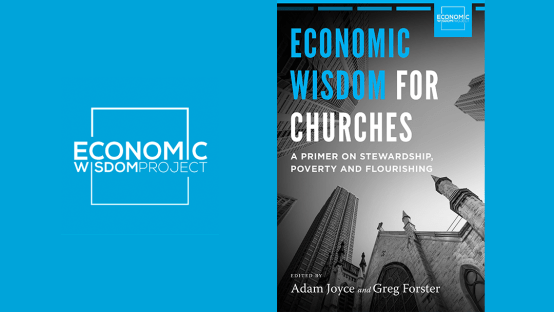
Economic Wisdom for Churches, our EWP book, is a small volume that packs a big punch. It features essays for local church leaders on critical issues facing their churches by Amy Sherman, Scott Rae, Tom Nelson, Charlie Self, Zachary Ritvalsky, James Thobaben, Jay Slocum, Jordan Ballor, Greg Forster and more. The essays are short and accessible enough to read through quickly, but offer the depth and insight to reframe the challenges churches are facing in their communities, overcome the paralysis of our polarized society, and bring the holy love of God out into our world.
The eBook is available for purchase from Amazon. For hard copies, contact us.
Below is an excerpt from a chapter in Economic Wisdom for Churches. Citations have been omitted.
Stewardship: Who Are We?
Jay Slocum
When God made Eve, he made economics. Our individualistic culture tends to think about faith and work only in terms of me, not we. But when God put Adam in the garden “to work it and keep it,” (Genesis 2:15) he said, “It is not good that the man should be alone” (Genesis 2:18). And it is not good that men and women today should think that they’re working alone, either. We are all working together as fellow stewards of God’s world. The mission of the human race is to exercise stewardship not alone, and this explains the need for economics.
Stewardship is also cross-generational. Adam and Eve were to “fill the Earth” (Genesis 1:28) and the biblical story shows us that God intends our stewardship to go somewhere over time. While the fullness of flourishing will not come until Jesus returns, we are not supposed to be waiting idly until then, as if it didn’t matter whether we leave the world any better than we found it. Still less should we be gobbling up the wealth of God’s world to feed our short-term desires, passing on to future generations a hollow shell and a mountain of debt! Our efforts cannot bring in the eschatological consummation, but moving the world closer to that vision rather than further from it is our stewardship responsibility.
The Pastor Wants to Talk about What?
As a pastor, when I begin talking about economics, people typically react in one of two ways.
The first reaction is disengagement. Hearing the word “economics,” my conversation partner immediately begins to imagine difficult formulas, complex realities, confusing graphs and charts delivered by gray-suited men with tidy haircuts and thick glasses. In this vast imagined sea of numbers and formulas, the listener has drifted off to Peter Pan’s Neverland.
Perhaps you are drifting even as you read these words.
Stimulate insight and engage students by assigning one of our exciting and catalytic EWP Talks! Michael Thigpen on economics in God’s creation design:
The second reaction involves a visceral defensiveness. In reaction to the word “economics,” the individual begins digging a mental ditch of either conservative or progressive ideology that defends his or her reasons for why our country’s economic problems exist. He or she doesn’t actually hear anything I say; having a pastor even bring up economics makes the listener feel under assault.
Of course, these reactions are reasonable given that much of our exposure to economics comes from either academic specialists or politicians. While economists and politicians play vital roles in the panoply of human society, many economists work with ideas that are too complex for the average individual to grasp, while some politicians reduce economics to propaganda. And their domination of the space associated with economics prevents level-headed discussion.
Economics in Everyday Life: Can You See It?
Most of the time, when I am talking about economics, I am not talking about the complexities of global economies or national politics, but of going on vacation with my extended family, navigating when to schedule having coffee with a friend in crisis or the complexities of an annual church yard sale. This is because economics, from a biblical perspective, is about how we steward our work and rest and play as part of our shared life together. [See John Bolt, Economic Shalom, p. xxxi]
Nathan Hitchcock on God’s “economy of all things”:
This summer, my wife, Catherine, and our two daughters (Emma and Lydia) spent ten glorious days in San Destin, Florida, with twenty of our relatives. We had a great time, and even though we were on vacation, there was an economy of relationships, emotions, monetary exchanges, politics and shared labor that required stewardship. Economics includes everyday life, the stewarding of the combined efforts of our work, rest and play.
To read more, purchase Economic Wisdom for Churches.
 The Green Room