
By Scott Rae, reprinted from the Oikonomia Network.
The Economic Wisdom Project is best known for our Economic Wisdom Project Talks, which are short, accessible, engaging and rich presentations suitable for use in classrooms and group discussions. But the EWP also features print resources, including our vision paper and our twelve elements of economic wisdom.
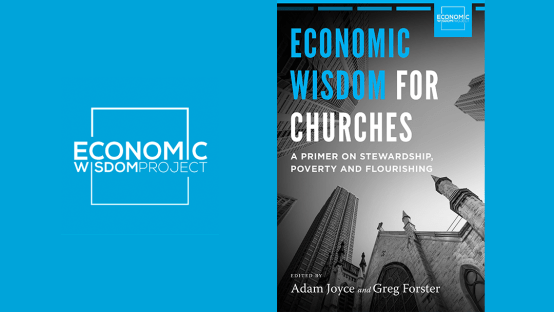
Economic Wisdom for Churches, our EWP book, is a small volume that packs a big punch. It features essays for local church leaders on critical issues facing their churches by Amy Sherman, Scott Rae, Tom Nelson, Charlie Self, Zachary Ritvalsky, James Thobaben, Jay Slocum, Jordan Ballor, Greg Forster and more. The essays are short and accessible enough to read through quickly, but offer the depth and insight to reframe the challenges churches are facing in their communities, overcome the paralysis of our polarized society, and bring the holy love of God out into our world.
The eBook is available for purchase from Amazon. For hard copies, contact us.
Below is an excerpt from Economic Wisdom for Churches. Citations have been omitted.
Economic Wisdom from the Bible
Scott Rae
From the beginning, we learn that God created the world and called it good, making the material world fundamentally good (Genesis 1:31). He further entrusted human beings with dominion over the earth – giving them both the privilege of enjoying the benefits of the material world, but also the responsibility for caring for the world. We also learn that, from the beginning, God has implanted his wisdom into the world, and given human beings the necessary freedom and tools – God-given intelligence, initiative, and creativity ‒ to uncover and apply his wisdom for their benefit (Proverbs 8:22-31)….
Responsible human dominion over creation involves exercising these creative qualities. In addition, since the image of God is fundamentally relational, this suggests that work is intended to be embedded in relationships….
Economics in the Old Testament
The Bible begins to address economics more frequently with the Old Testament law. Israel became a nation “under God” which required a set of guidelines resembling a constitution. Many of these guidelines in the OT law involve economics. The purpose of Israel’s constitution was to show how they could model God’s righteousness in the way they lived together as a nation – that is, how they could become a “holy nation” (Exodus 19:5-6).
When it came to economics, there were two main ways that the Israelites would accomplish this. One was to make sure that their society was fair – that when people made exchanges, they did so without engaging in fraud or cheating each other. For example, the law mandated that the scales used to weigh out measures of goods were accurate (Leviticus 19:35-36, Deuteronomy 25:13-16). The law assumes that individuals could legitimately own and accumulate property, since laws prohibiting theft and fraud only make sense if private property is legitimate. But the law also makes it clear that God is the ultimate owner of everything (Leviticus 25:23).
The second way that they were a “holy nation” in economics was to ensure they cared for the poor properly (Deuteronomy 15:1-11, 26:12-13). Their society assumed that people were responsible for taking care of themselves and their families. Old Testament law focused on how to provide for those who could not provide for themselves – that was the definition of the poor.
The law structured many aspects of economic life to ensure that the poor were not without opportunity to take care of themselves. For example, the law mandated a tradition known as “gleaning” where the poor could make their way through another’s agricultural field and gather some of the produce for themselves (Leviticus 19: 9-10)….
Stimulate insight and discussion by assigning one of our exciting and catalytic EWP Talks! Joshua Jipp on Jesus the economic teacher:
God’s heart for the poor is revealed throughout the Psalms and other poetic literature in the Old Testament. The marginalized, vulnerable, and oppressed occupy a special place in the heart of God, because he is their only defender and advocate. For example, Psalm 10:17-18 says “You hear, O Lord, the desire of the afflicted; you encourage them and you listen to their cry, defending the fatherless and oppressed, in order that man, who is of the earth, may terrify no more.”…
Another important aspect of caring for the poor comes out of the wisdom books – that of individual responsibility for prosperity….The Bible is not teaching anything like a “prosperity theology” in which God always automatically rewards righteousness with material wealth. Even the Proverbs acknowledge that wealth doesn’t last forever (Proverbs 27:24). The general pattern in the Bible, however, is that prosperity is a matter of personal responsibility – namely, hard work, diligence, and perseverance (Proverbs 13:11, 14:23, 16:26, 20:13, 28:19, 20, 22, 25). The emphasis seems clear: individual responsibility, a strong work ethic, and other “entrepreneurial” character traits such as initiative and perseverance are critical to a life of economic prosperity….
As important as these character traits are, it is also important to recognize that a person’s prosperity is ultimately a blessing from God. This was more obvious in the agricultural economy of the ancient world. People were dependent on natural forces such as rainfall to have a sufficient harvest. But it is no less true in our information-based economy today. The proverbs indicate that it’s the blessing of God that makes a person prosperous (Proverbs 10:22), and that God is the one who enables us to enjoy the fruit of our labors. He says that it’s a good thing that we can enjoy life as his good gift (Ecclesiastes 2:24-25, 5:18-20).
Economics in the New Testament
In the New Testament, Jesus takes up where the prophets left off. The poor were just as important to Jesus as they were to the prophets. When the followers of John the Baptist (who was in prison at the time) asked Jesus if he was indeed the Messiah who was to come, he answered in terms that could have been taken directly from the prophets. He put it like this: “Go back to John [the Baptist] and tell him what you have seen and heard – the blind see, the lame walk, the lepers are cured, the deaf hear, the dead are being raised to life and the good news is being preached to the poor” (Matthew 11:4-5). The evidence that Jesus was who he claimed to be extended beyond his miracles to the identities of the beneficiaries of those miracles – the poor, marginalized, and vulnerable. Similarly, when he spoke of final judgment and what would separate his true followers from the pretenders, he made it clear that how someone treats the poor is a critical indication of a person’s spiritual maturity. This is likely what Jesus meant when he said, referring to the hungry and the needy, “I tell you the truth, when you did it to the least of these my brothers, you were doing it to me” (Matthew 25:40).
Bruce Fields on the humble dignity of “striving in God’s image”:
To read more, purchase Economic Wisdom for Churches.
 The Green Room