
By Bruce Baker, reprinted from the Oikonomia Network.
The Economic Wisdom Project is best known for our Economic Wisdom Project Talks, which are short, accessible, engaging and rich presentations suitable for use in classrooms and group discussions. But the EWP also features print resources, including our vision paper and our twelve elements of economic wisdom.
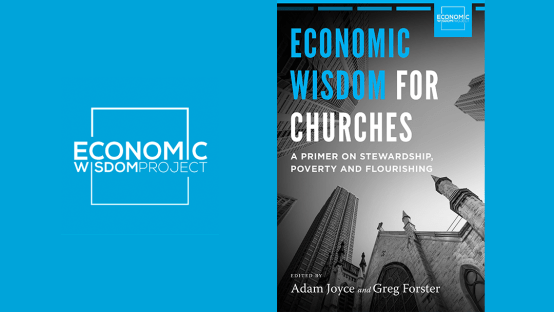
Economic Wisdom for Churches, our EWP book, is a small volume that packs a big punch. It features essays for local church leaders on critical issues facing their churches by Amy Sherman, Scott Rae, Tom Nelson, Charlie Self, Zachary Ritvalsky, James Thobaben, Jay Slocum, Jordan Ballor, Greg Forster and more. The essays are short and accessible enough to read through quickly, but offer the depth and insight to reframe the challenges churches are facing in their communities, overcome the paralysis of our polarized society, and bring the holy love of God out into our world.
The eBook is available for purchase from Amazon. For hard copies, contact us.
Below is an excerpt from Economic Wisdom for Churches. Citations have been omitted.
Introduction: The Economic Story
Bruce Baker
Pastors and churches tell us the true story of our world, the story of how the real world really works. But this story doesn’t become fully real for us until it is related to all the other stories that define our lives. One of the most important stories that defines our lives is the story of the economy we live in. If we want to be disciples in all our lives and not just inside the church building, we need to know how the Christian story we hear in church relates to the economic story we hear throughout the marketplace and media.
In the months leading up to the crash of 2008, Chuck Prince, CEO of Citibank, was asked to justify his firm’s bullish appetite for leveraged lending. He acknowledged the risk of an impending liquidity crunch, and yet explained that he really had no other option but to play along with the rest of the market: “[As] long as the music is playing, you’ve got to get up and dance. We’re still dancing.” [Financial Times, July 9, 2007]
Prince’s glib remark reveals a generally accepted confidence that economic markets are a self-governing force of nature, as well as a sense of moral rectitude in “dancing to the music.” As the Dow and S&P climb to new heights, this might be an opportune time to ask: Who’s calling the tune?
Stimulate insight by assigning one of our exciting and catalytic EWP Talks! Deborah Gill on the Great Commission as a call to “discipleize” all of life:
The recent “near-death experience” of the financial markets, as Joseph Stiglitz has called it, rocked people’s faith in the ability of the market to self-correct (i.e., prune itself of exploitative and harmful transactions). Alan Greenspan, for one, could not fathom such a catastrophic failure of a system based on self-interest: “Those of us who have looked to the self-interest [of private companies to promote the market system] – myself especially – are in a state of shocked disbelief.” [New York Times, Oct. 23, 2008]
Greenspan’s overconfidence in the principle of self-interest reflects what might be called a morality gap in our culture. This gap is due in part to the gradual decline of religious narratives as sources of cultural truth. Having lost touch with a larger narrative capable of providing a moral framework based in transcendent values, we have seized upon a narrative based in sheer pragmatism – namely, that the market is a (generally beneficent) force of nature driven by self-interest. Self-interest is pragmatic to the extent that it creates jobs, wealth, and productivity. But we need a richer story.
What we need is a narrative capable of absorbing, assimilating, and transcending the inexorably complicated trade-offs inherent in the market system. Religious narratives help people make sense of life by providing the context of a moral universe in which people accept their God-given responsibility to care for strangers, steward the environment, and build economic shalom.
In the absence of a telos, or higher purpose based in a transcendent narrative, lesser narratives will emerge to justify the premise of a moral market. The pragmatism of self-interest thus emerges by default as justification for the goodness and power of the market. It all comes down to natural forces, fueled by self-interest.
Chris Armstrong on how the sacredness of the church offers the world an alternative way to see itself:
To read more, purchase Economic Wisdom for Churches.
 The Green Room