
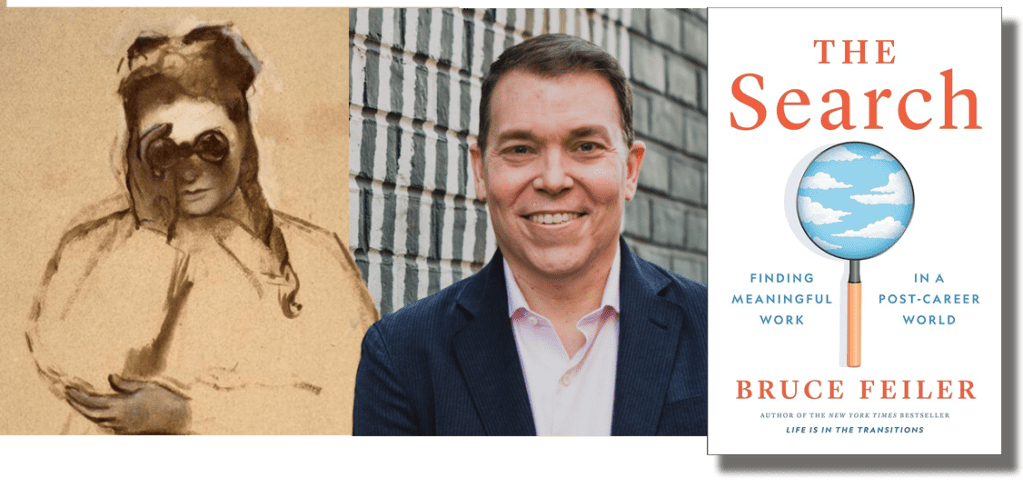
By David Gill, reprinted from The 313.
Bruce Feiler is the author of thirteen books including Abraham: A Journey to the Heart of Three Faiths (2005), America’s Prophet: Moses and the American Story (2009), Walking the Bible: A Journey by Land Through the Five Books of Moses (2014), and The First Love Story: A Journey Through the Tangled Lives of Adam and Eve (2018). This is worth noting because, despite all this praiseworthy exploration of biblical history, Feiler’s newest book The Search: Finding Meaningful Work in a Post-Career World fails to draw on the abundant history and theology of work and calling in the Bible.
Feiler is certainly on target in his descriptions of the changing world of work in our era. Largely because of technological developments, the old dream of a more-or-less stable career and job, beginning from a specialized education and apprenticeship and proceeding with job advancements all the way to retirement has virtually disappeared. Work specialties and job descriptions are in constant flux. Companies and employers are in flux – and are no more committed to providing long-term loyalty to workers than (most) workers are committed to employers. Given this environment, how must we change our thinking and approach to our work lives?
Feiler uses the term “workquake” to describe the disruptions we will all encounter. The “lies” we must reject are (1) you have a career, (2) you have a path, (3) you should (or can) just follow your bliss, (4) you can make a ten-year plan, (5) you can keep your personal life separate from your work life, and (6) always keep your eye on the financial bottom line. In the new “Work 360” world we should value concepts like “main job,” “side job”,” “hope job,” “care job,” and “ghost job.” The “one truth” about work today is that you, yourself, are the answer. “Only you can provide the help you want and the direction you need” (p. 112).
So the six critical questions we must ask ourselves are: (1) who am I, what kind of person do I want to be? (2) what kind of work do I want to do? (3) what do I want to do for work at this moment in my life? (4) where? what kind of place do I want to be for my work? (5) what is the purpose of my life I want to express in my work? And (6) what is my sense of what I ought to do right now for meaningful work? Feiler gives dozens of examples in his writing on all these subtopics.
The Search is a valiant attempt to help today’s workers face up to the new work environment, and its counsel has value and could help many readers. Unfortunately, Feiler’s approach is in the end too elitist, optimistic, and subjective. It is elitist in that most workers will not have the privilege or capacity to shape their work story as he wishes. Most workers will have to take whatever paid jobs they can find just to survive. They do not have the luxury to succeed with his plan. This includes the highly-educated. It is also too optimistic. Even for the privileged who can pursue the Feiler path, I don’t think most workers can escape the meaninglessness and frustration of working as replaceable appendages to our technological system. It is too subjective from start to finish, too dependent on “ME” – my insight, my creation of meaning, my lack of community, my lack of a bigger story and purpose.
There is no full escape from “the sweat of our brow,” the pain and frustration, and the technologically-imposed demands of our work. But the biblical story – a biblical worldview and philosophy of work – can provide a strong antidote. Adam and Eve, Abraham, and Moses (with whom Feiler is familiar), to say nothing of Joseph, Daniel, Jesus, Paul, and company, could put us on the right job search track. In this approach we don’t anchor ourselves to the individual self. We don’t begin or end in the interiority of Me. Instead, we begin with who God is and the work that God does as Creator, Sustainer, provider of wisdom, advocate for justice and righteousness, and Redeemer (healer, liberator, reconciler, care-giver). As people made in the image and likeness of this God, these “God-jobs” become our mandate and possibility – always within the context of a community helping us discern and carry out these functions in ways that express love for God as well as love for our neighbors (colleagues, customers, competitors, et al). Whether we are writing code, managing organizations, waiting tables, designing buildings, or sweeping streets we can seek ways to express these master themes in God’s work. We have a worldview anchored in the God who transcends our changing, fallen world and therefore brings a critical/constructive, realistic but hopeful way of working no matter what or where.
Inset Art: Young Woman with Field Glasses | Edgar Degas
 The Green Room